Order by 3:00 PM Monday – Friday to receive your parcel the next day.
Orders placed after 3:00 PM ship the next working day on the same 24‑Hour service and usually arrive the following day.
See Full Delivery Information.
Overview
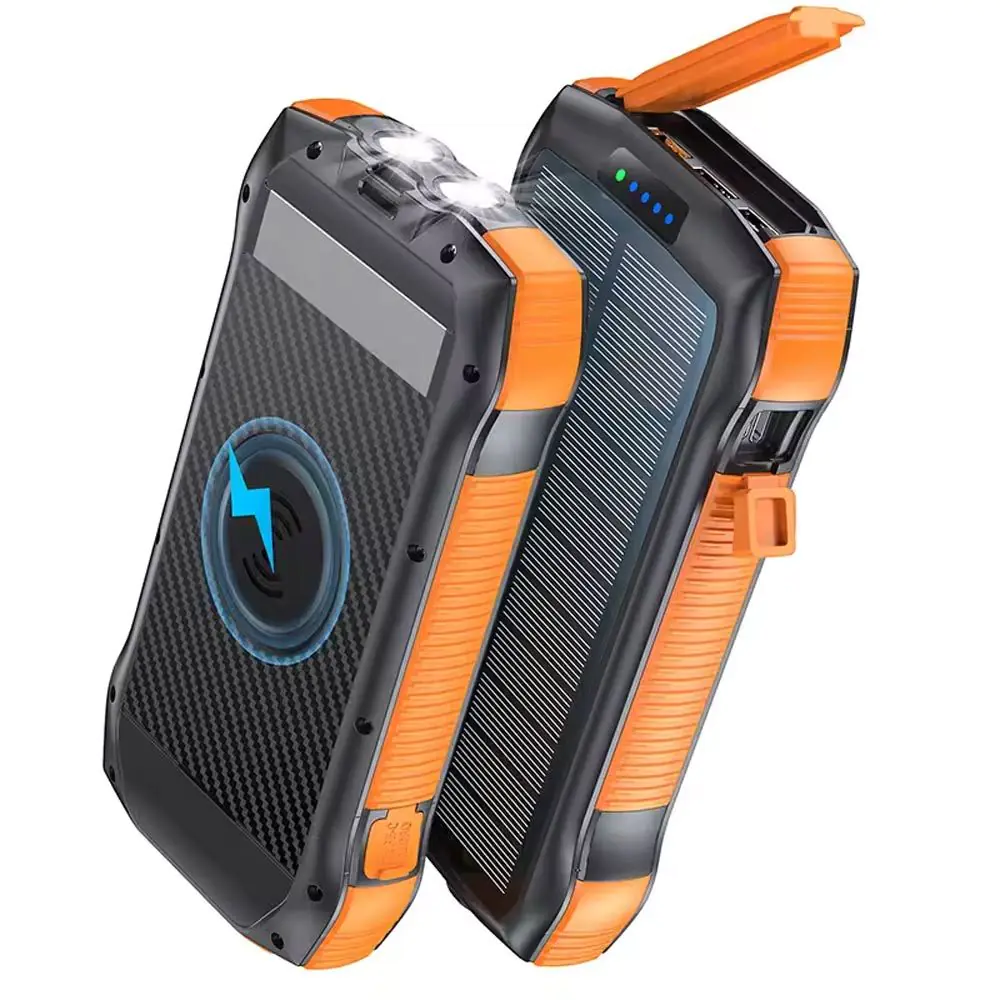
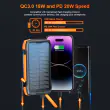
Solar power bank with 20000 mAh real capacity, IP67 waterproof rating, 10W wireless charging, PD 20W fast charging, and a rugged shockproof build for charging smartphones and tablets outdoors.
20000 mAh Li-Polymer rechargeable battery (real capacity)
IP67 waterproof, shockproof & dust-proof
10W Qi wireless charging
PD 20W USB-C fast charging (input & output)
Solar panel: 1.6W
Input: Type-C (PD 18W) 5V/3A, 9V/2A
Input: Micro USB 5V/3A, 9V/2A
Output: USB-A x3 + USB-C + Wireless
LED flashlight (3W/360LM), camping light & SOS mode
Whether you're heading out on a camping trip, tackling a long hike, or simply need a reliable backup battery for everyday life, this 20000 mAh solar power bank has you covered. Combining PD 20W fast charging, 10W Qi wireless charging, and a built-in solar panel in one rugged, IP67-rated package, it's designed to keep all your devices powered up wherever you are.
Unlike standard power banks, this one is built to survive the outdoors. The IP67 waterproof, shockproof, and dust-proof casing means it can handle rain, mud, drops, and dust without missing a beat. And with five simultaneous charging outputs — three USB-A ports, one USB-C PD port, and a wireless charging pad — you can charge your phone, tablet, earbuds, and a friend's device all at the same time.
IP67 waterproof, dust-proof and drop-resistant — built for every outdoor adventure
IP67 Waterproof & Shockproof | PD 20W Fast Charging | 10W Wireless Charging | Solar Panel | LED Camping Light
Use it as a portable power bank to top up devices throughout the day, then recharge it via USB-C, Micro USB, or the built-in solar panel when you're outdoors. The 20000 mAh real capacity provides multiple full charges for most smartphones — typically four to five full charges for an iPhone or Samsung Galaxy. The built-in 10W wireless charger means you can simply place your Qi-compatible phone on top to charge without cables, making it incredibly convenient when you're on the move.
Need to recharge the power bank itself quickly? Using a 20W USB-C adapter, you can fully recharge it in around 6 hours. The solar panel provides a handy emergency top-up when mains power isn't available, and the LED battery indicator keeps you informed of remaining charge at a glance.
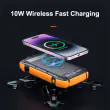
Simply place your phone on top to charge wirelessly
Wireless Charging — Just Place & Charge
One of the standout features of this power bank is the built-in Qi wireless charging pad. Simply place any Qi-compatible smartphone on top of the power bank and it begins charging automatically — no cables needed. It supports 5W, 7.5W, and 10W wireless output, so it works perfectly with the latest iPhones (which charge wirelessly at 7.5W) and Samsung Galaxy devices (which support up to 10W). It's a real game-changer when you're camping or travelling and don't want to fuss around with cables in the dark.
Key Features
20000 mAh Real Capacity – Li-Polymer battery provides multiple full charges for smartphones and tablets, typically 4–5 charges for most phones
PD 20W Fast Charging – USB Type-C output delivers rapid charging for compatible devices, getting your phone to 50% in around 30 minutes
10W Wireless Charging – Qi-compatible wireless charging pad built-in (5W / 7.5W / 10W) for cable-free convenience
Solar Charging – 1.6W solar panel (5.5V/290mA) for emergency top-ups when you're off-grid
IP67 Waterproof – Fully waterproof, shockproof and dust-proof rugged design that handles rain, mud, and drops
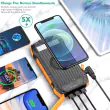
Multiple Outputs – Triple USB-A ports + USB-C PD port + wireless charging — charge up to 5 devices simultaneously
LED Camping Light – Built-in 3W/360 lumen LED flashlight with SOS mode, perfect for camping and emergencies
Compact & Portable – Measures just 178 x 90 x 30mm and weighs only 530g, easily fits in a rucksack or jacket pocket
Rugged design with solar panel, wireless charging pad, and triple USB output
Built for the Outdoors
This isn't a power bank that needs to live in a drawer. With its IP67 waterproof rating, it can be fully submerged in up to 1 metre of water for 30 minutes and keep working. The rubberised, shock-absorbing bumpers protect it from drops and knocks, while the sealed port covers keep dust and debris out of the charging connections. Whether you're caught in a downpour on a hillside, working on a muddy building site, or relaxing by the pool, this power bank is built to take it.
The built-in LED flashlight is genuinely useful too — at 3W and 360 lumens, it throws out a powerful beam with a range of up to 50 metres. There's also a camping light mode for softer, ambient lighting around your tent, and an SOS strobe mode for emergencies. All controlled by a single button on the side.
IP67 rated — fully waterproof, shockproof, and dust-proof
Fast Charging That Actually Makes a Difference
With PD 20W output via the USB-C port, this power bank charges compatible phones significantly faster than a standard 5W charger. You can expect an iPhone 15 to reach around 50% in approximately 30 minutes, making it ideal when you need a quick boost before heading out. The USB-A1 port also supports Quick Charge with 5V/3A, 9V/2A, and 12V/1.5A output, while the two additional USB-A ports provide standard 5V/2.1A charging for accessories like earbuds, smartwatches, and Bluetooth speakers.
Recharging the power bank itself is equally flexible. Plug in via USB-C with a 20W adapter for a full charge in around 6 hours, use the Micro USB input as an alternative, or let the solar panel trickle-charge it throughout the day when you're outdoors. The solar panel won't fully charge the unit on its own in a practical timeframe, but it's a valuable supplement that can add meaningful charge over a sunny day's hiking.
Compatible Devices
Works with all Qi-compatible smartphones for wireless charging, and charges virtually any USB device including:
Apple iPhone – iPhone 16, 15, 14, 13, 12 (all models including Pro, Pro Max, Mini, Plus) and iPhone 11, XS, XR, X, 8, 7, 6S series (wired charging)
Samsung Galaxy – S25, S24, S23, S22, S21, S20 series and Note 20, 10, 9, 8, 5 series
Huawei – P60, P50, P40, P30, P20 Pro, Mate 40, 30, 20 Pro series
Xiaomi – Mi 14, 13, 12, 11, 10, 9, 8 Pro, Redmi series
For reliable UK power, always use mains charging as your primary method, with solar as a backup or for emergencies. Follow these steps:
1. Initial Charge (Essential)
First use: Fully charge your power bank via mains (Type-C cable included).
Duration: Charging time depends on battery size. Example: a 20,000mAh bank may take 6–8 hours; a 30,000mAh bank may take 8–10 hours; larger banks will take longer.
LED indicator: Shows charging progress.
2. Solar Panel Positioning
Best angle: In the UK, tilt the panel at 30–40° in spring/autumn, and flatter (10–20°) in summer when the sun is higher.
Panel direction: Always face the panel directly towards the sun for best results.
Panel size matters: Larger panels (e.g. 6–8W folding panels) will charge much faster than small built-in panels (1–2W).
3. Estimating Solar Charging Time
Solar panel output: A typical built-in panel (1–2W, ~200–400mA) may add 1,000–2,000mAh per sunny summer day.
Folding panels: A 6–8W folding panel can add 3,000–4,000mAh per day in strong sun.
Calculation:Daily mAh added ≈ panel current (mA) × hours of direct sun. For example, a 400mA panel × 5 hours = 2,000mAh.
Battery size: Divide your battery capacity by the daily solar input to estimate full charge time. (e.g. 20,000mAh ÷ 2,000mAh/day = 10 days in sun)
UK Charging Recommendations
Spring/Summer Use
Solar works best April–August, especially on clear days.
6–8 hours of direct sunlight needed for meaningful charge.
Keep panel clean from pollen, dust, or bird droppings.
Expect 1,000–4,000mAh per day depending on panel size and sun strength.
Autumn/Winter Use
Rely on mains charging October–February.
Solar may only maintain charge, not increase it, due to low sun and short days.
Store indoors if temperatures drop below 0°C.
Solar Charging & Glass – What You Need to Know
Direct sunlight is essential: For best results, place your charger outside, facing the sun. Avoid charging through glass or plastic covers.
Behind glass (car or indoors): Car windows and home glazing can block 50–70% of solar energy. Charging speed will drop sharply, and may not work at all on cloudy days.
Why? Modern car glass is designed to filter UV and reduce heat, which also greatly reduces the type of sunlight your charger needs.
Tip: If you must use solar in a car, place the power bank as close to the glass as possible on a sun-facing dashboard. Expect much slower charging.
Fact: Solar charging behind most car windows is typically only 20–40% as effective as outdoors. For fastest solar charging, always use direct, unobstructed sunlight.
Maintenance Tips
Panel care: Wipe clean with a microfiber cloth weekly.
Mains priority: Charge fully before trips (solar is backup).
Storage: Keep 50% charged if unused for months.
Temperature caution: Avoid leaving your power bank in hot cars or freezing conditions.
Example: A 2W built-in panel may add up to 1,500mAh per sunny summer day. An 8W folding panel can add up to 4,000mAh per day in strong sun. Actual results depend on weather, panel angle, and location.
This hybrid charger combines solar and mains charging for reliable power anywhere. Below we explain how it works for all models, including those with built-in and folding solar panels.
1. Dual Charging Methods
Solar Charging: Converts sunlight into power. Built-in panels are typically 1–2W (200–400mA); folding panels may be 6–8W (1200–1600mA).
Mains Charging: Fast charging via Type-C, Micro USB, or Lightning (model dependent).
Wireless Charging: Some models support Qi wireless charging for compatible phones (see product details).
The power bank automatically uses the fastest available charging source.
2. Power Storage
High-capacity lithium battery (e.g. 20,000–46,000mAh, varies by model).
Stores energy from solar or mains for later use.
Long standby: Holds charge for up to 3–4 months when unused.
3. Device Charging
Multiple outputs: Dual USB-A, Type-C, and sometimes wireless (see your model).
Fast charging: Up to 2.4A per port (model dependent).
Auto-detects and adjusts for your device's needs.
Solar Performance & Optimization
Panel angle: For best results in the UK, tilt the panel at 30–40° in spring/autumn, and flatter (10–20°) in summer when the sun is higher.
Panel size matters: Built-in panels (1–2W) may add 1,000–2,000mAh per sunny day; folding panels (6–8W) can add 3,000–4,000mAh per day.
Estimate your charge: Daily mAh added ≈ panel current (mA) × hours of direct sun. Example: 400mA × 5 hours = 2,000mAh.
Battery size: Divide your battery capacity by daily solar input to estimate full charge time. (e.g. 20,000mAh ÷ 2,000mAh/day = 10 days in sun)
Glass warning: Charging behind car or house glass can reduce solar input by 50–70%. For best results, use outdoors in direct sunlight.
Example: A 2W built-in panel may add up to 1,500mAh per sunny summer day. An 8W folding panel can add up to 4,000mAh per day in strong sun. Actual results depend on weather, panel angle, and location.
Pro Tips for Best Performance
Initial charge: Fully charge via mains before first use. Charging time depends on battery size (e.g. 20,000mAh: 6–8 hours; 30,000mAh: 8–10 hours; larger banks take longer).
Solar charging: Works best in direct, unobstructed sunlight. Clean the panel regularly for maximum efficiency.
Panel angle: Adjust the tilt for the season—flatter in summer, steeper in spring/autumn.
Storage: Recharge every 3–4 months if unused. Store at 50% charge for long-term storage.
Temperature: Avoid charging or storing in extreme heat or cold (e.g. hot cars, freezing conditions).
Expectations: Solar is for backup or emergency use. Mains charging is always faster and more reliable.
Example: A 2W built-in panel may add up to 1,500mAh per sunny summer day. An 8W folding panel can add up to 4,000mAh per day in strong sun. Actual results depend on weather, panel angle, and location.