Order by 3:00 PM Monday – Friday to receive your parcel the next day.
Orders placed after 3:00 PM ship the next working day on the same 24‑Hour service and usually arrive the following day.
See Full Delivery Information.
Overview
A proper bollard, not a stake light: 60 cm of black die-cast aluminium bolted to the ground, with a round solar cap that throws an even 360° ring of light onto the path below. One button does everything — press for full brightness, again for the low setting, and hold it to swap between white and warm white. UK stock, dispatched from Great Britain.
60 cm tall, Ø23.5 cm cap, bolt-down base with three fixing holes
Die-cast aluminium body with a frosted polycarbonate 360° diffuser
Lab-tested 106–112 lumens on full power (manufacturer rating 230 lm)
White or warm white — hold the button for three seconds to switch
Two brightness levels: full for the path, low for all-night ambience
Automatic dusk-to-dawn — comes on when the light fades, off at sunrise
3.7 W solar panel in the cap, 3.7 V 4000 mAh replaceable Li-ion battery
Manufacturer's run time 9–11 hours from a 5–6 hour charge
A Bolt-Down Solar Bollard for Paths, Drives and Borders
Most solar path lights are plastic stakes that wobble in the border. The Kew is a 60 cm die-cast aluminium bollard fixed to paving or a concrete pad, with a round solar cap that spreads an even 360° ring of light onto the ground around it. It comes on by itself at dusk, and one button gives you full or low brightness in white or warm white. UK stock, dispatched from Great Britain.
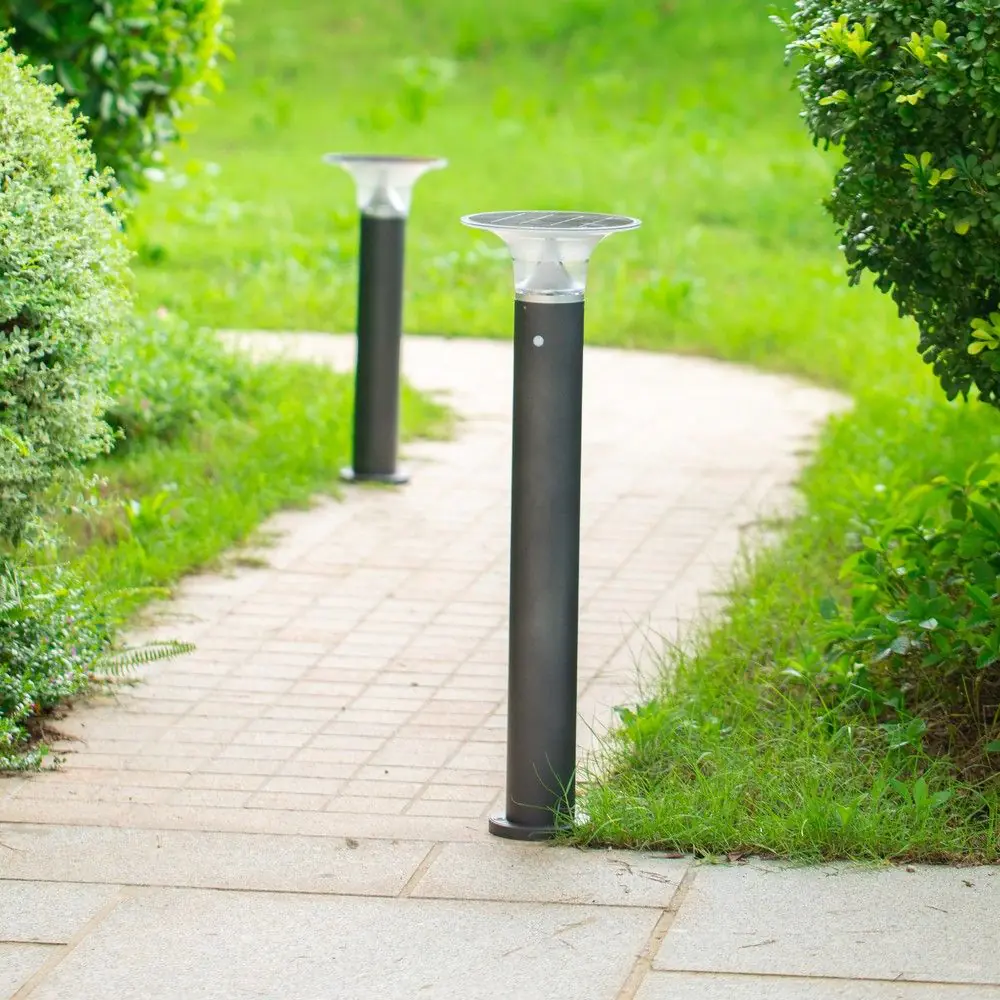
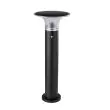
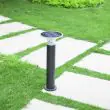
The Kew — die-cast aluminium bollard, 60 cm tall, with the solar panel set flat into the cap
Built Like Street Furniture
The column and base are one-piece die-cast aluminium, powder-finished in black, with three fixing holes on a 90 mm pitch. Expansion bolts and an Allen key come in the box; it goes down onto slabs, brick, concrete or a small pad set into a border, and it stays put. The frosted polycarbonate diffuser under the cap is impact-resistant and does not yellow. At 3.1 kg boxed this is a different class of object from a stake light.
What goes into it — die-cast base, aluminium column, diffuser, LED board, solar cap, switch and fixings
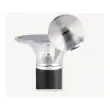
The 3.7 W solar panel sits flat in the cap, so it charges from any direction
Honest Light Output
The maker rates the Kew at 230 lumens. The lab report in its own specification sheet measures 106 lumens in cool white and 112 lumens in warm white on a full charge, and that is the figure we put in the name. It is the right amount for a path: a clear pool of light on the ground within a couple of metres, soft enough not to glare across a lawn or into a window. It is not a security light — for that, see the Powerbee Motion Sensor Solar Bollard at 1000 lumens.
The LED board sits in the neck under the cap and fires into the 360° diffuser
Two Colours, Two Levels, One Button
Hold the button on the column for about three seconds and the light swaps between white (6500–7000K) and warm white (2800–3100K), so a row of Kews can match cool modern rendering or the warm glow of coach lanterns. Short presses step through full brightness, a low setting and off. The setting is remembered, so once each light is set you leave it alone; the dusk sensor in the cap does the switching on and off every day.
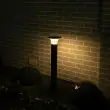
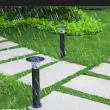
Kew bollards lining a garden path at dusk
Run Time
The manufacturer quotes 9–11 hours a night on full brightness from a 5–6 hour charge; the low setting runs longer. As with any solar light, run times are shorter in winter and depend on the weather — the low setting is there for the darker months.
Replaceable Battery, Weather-Resistant Body
The 3.7 V 4000 mAh lithium-ion pack is an 18650 cell type held in a battery box inside the column; undo the hex screw, unplug the old pack and plug in the new one. The body is rated IP44 — rain, spray and frost are fine, standing water is not — and it operates from −15 °C to 45 °C. Two-year warranty.
Yes, but it has a bolt-down base rather than a spike, so it needs something solid under it. Bed a 30 cm paving slab or a small concrete pad level with the soil, then bolt the base to that with the supplied expansion bolts.
How bright is 110 lumens?
About the same as a candle-style garden lantern: enough to light the path and steps for two metres or so around the bollard, without glare. The manufacturer's headline is 230 lumens; we quote the 106–112 lumens measured in the lab test in their own specification sheet.
Does it come on by itself?
Yes. Once you have pressed the button to choose full or low brightness, the light sensor in the cap switches it on at dusk and off at sunrise every day. Keep it away from porch and street lights, which can fool the sensor into thinking it is still daytime.
Can I change the colour of the light?
Yes. Hold the button under the waterproof cover for about three seconds and it swaps between white and warm white. Both colours have the same full and low settings, and the choice is kept, so a row of lights can all be matched.
Is the battery replaceable?
Yes. The 3.7 V 4000 mAh pack sits in a battery box inside the column. Undo the hex screw, lift the box out, unplug the old pack and plug in the new one — no soldering.
Rate this product
0/5
0 Reviews
Please rate this product, describe its advantages and disadvantages, please share your impression about its use
The Kew 110 Lumen Solar Bollard Light – White or Warm White, 2 Brightness Levels, 60cm bolts down rather than pushing into the ground. Allow half an hour with a drill: three holes, three expansion bolts, done. It needs a hard surface — paving, concrete, a stone step or a small concrete pad set in the border.
Step 1 — Choose the Spot
Full sun on the cap for most of the day; the panel lies flat, so overhanging shrubs and fence shadows cost you charge
A level hard surface: slabs, concrete, brick or a purpose-poured pad. On soil, set a 30 cm paving slab first
Keep it away from porch lights and street lamps — the dusk sensor in the cap will think it is still daytime
Space several lights 2–3 m apart along a path for a continuous run of light
Step 2 — Bolt It Down
Stand the base in position and mark the three holes (90 mm pitch)
Drill the holes to suit the supplied expansion bolts and push the bolt sleeves in
Set the base over the sleeves and tighten the nuts with the Allen key and a small spanner
Give the column a gentle rock — nothing should move
Step 3 — Switch On and Choose Your Setting
Open the small waterproof cover on the column. One button controls everything:
Press once: on, full brightness
Press again: low setting — a softer glow that stretches the battery
Press a third time: off
Hold for about 3 seconds: swaps between white and warm white; both colours have the same two levels
Before first use, leave it switched on in the sun for a full day so the battery starts from a proper charge. It only lights after dark; to test it in daylight, cover the whole cap with something opaque.
Location and Seasonality
Give the cap open sky: it charges from direct sun, and every hour of shade is an hour of charge lost
We would not advise a north-facing spot or anything overhung by trees, porches or eaves
Keep it clear of porch and street lighting at night, which can stop the dusk sensor switching on
Expect the most from April to September. In the darker months the sun is low and the days are short, so run times shorten and a dull week will show — that is normal for every solar light, not a fault
On short winter days use the low setting to make the charge go further
Maintenance
Wipe the solar cap clean every few weeks — dust and bird droppings cut the charge more than you would expect
The 18650 battery pack is replaceable: undo the hex screw on the column, lift out the battery box, unplug the old pack and plug in the new one
In winter the low setting makes the most of the shorter days
The Kew 110 Lumen Solar Bollard Light – White or Warm White, 2 Brightness Levels, 60cm is a self-contained solar light. The panel in the cap charges the battery in the column by day; when the light fades the controller switches the LEDs on behind the frosted diffuser at whichever brightness and colour you last chose, and switches them off again at sunrise.
Charging
The 3.7 W panel sits flat on top of the cap, so it catches sun from every direction without needing to face south. A bright day gives a full charge in 5–6 hours; the 4000 mAh lithium-ion pack then carries the light through the night. It is the same 18650 cell type used in power tools, and it unplugs for replacement rather than being sealed in.
The 360° Glow
The LEDs sit in the neck under the cap and fire into a polycarbonate diffuser that wraps the whole way round, so the light spreads evenly onto the ground on all sides with no dark segment. Lab-tested output on a full charge is 106 lumens in cool white and 112 lumens in warm white — a soft pool of path light rather than a floodlight. Hold the button to pick the colour: white for a crisp modern look on stone and gravel, warm white to match lanterns and house lighting.
Two Brightness Levels
Full brightness is for lighting the path; the low setting is for leaving the bollard on all night as a marker or for ambience, and it is the one to use in winter when the panel sees a fraction of the summer sun. The manufacturer quotes 9–11 hours on full from a full charge; the low setting runs longer.
Weather and Winter
The body is die-cast aluminium, powder-finished in black, with an IP44 rating — fine for rain, spray and frost, not for standing in water. It works from −15 °C to 45 °C. As with any solar light, run times are shorter in winter and depend on the weather.