Order by 3:00 PM Monday – Friday to receive your parcel the next day.
Orders placed after 3:00 PM ship the next working day on the same 24‑Hour service and usually arrive the following day.
See Full Delivery Information.
Overview
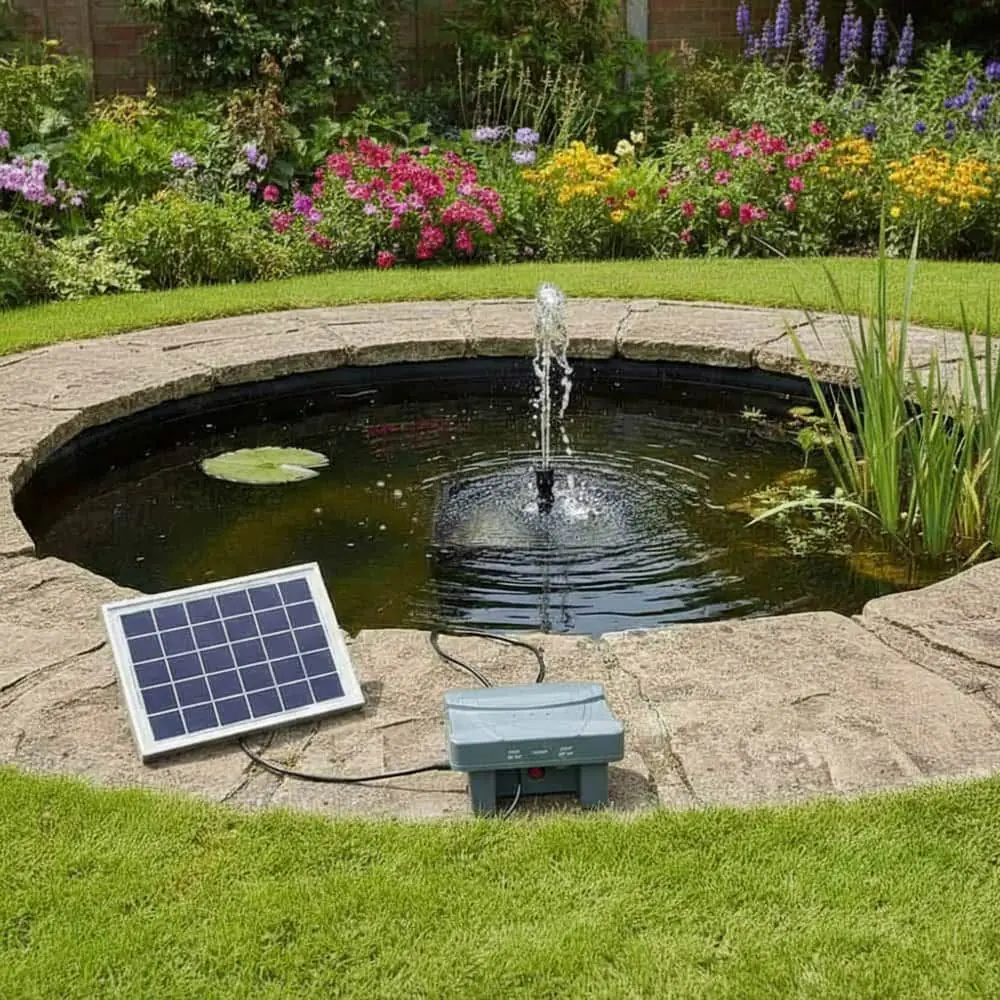
Combines a powerful 1400 LPH solar pump with a 20-litre filter bucket and MPPT battery backup — keeps your pond clear and circulating day and night.
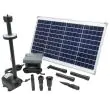
1400 LPH pump with 40W MPPT solar panel
LiFePO4 battery — runs up to 14.5 hours/day
20-litre filter bucket with dual filter pads
Ponds up to 2,000L (1,500L with fish)
Optional 5W UV clarifier kills green algae
Adjustable flow control for fine-tuning
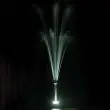
9 white LEDs with auto dusk-to-dawn mode
Zero running costs — 100% solar powered
Seasonal performance: Best in spring and summer; limited winter operation depends on strong direct sunshine reaching a well-positioned, unshaded solar panel.
The SE 2000 pump pushes 1400 litres per hour through a 20-litre filter bucket, keeping your pond clear and well-circulated without mains power. The LiFePO4 battery stores energy throughout the day so the system keeps running through cloud and into the evening — up to 14.5 hours on a sunny day. Add the optional 5W UV clarifier to kill green algae at the source.
The SE 2000 is one of our most popular pond pumps — proven across thousands of installations. Paired with the MPPT battery controller, it charges faster and runs longer than standard solar pumps.
SE 2000 Pump
1400 LPH flow rate at 0m head
2.0m maximum water lift
Adjustable flow dial
Dry-run and overheat protection
19mm outlet for tubing
40W MPPT Solar Panel
40W polycrystalline panel
MPPT technology for maximum charge
Ground spike included
5m cable for flexible placement
Works in overcast British weather
LiFePO4 Battery
12.8V 7,600mAh capacity
7.5 hours minimum runtime
Up to 14.5 hours on sunny days
9 white LEDs with dusk sensor
12V light output for UV clarifier
Filtration & Water Clarity
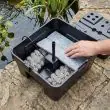
The 20-litre SPF-20 filter bucket is three times larger than the standard eco filters included with smaller kits. More filter volume means longer intervals between cleaning and better water quality.
20L Filter Bucket
20-litre capacity — 3x standard eco
Dual mechanical filter pads
2x mesh media bags (media optional)
Pump pushes water through the bucket
No need to elevate — sits at pond level
Optional: UV Clarifier (+£59.99)
5W LED UVC kills green algae
Destroys bacteria and viruses
Connects inline: pump → UV → filter
Powered from battery box (12V DC)
19→25mm adapter included
Suitable Ponds
Wildlife ponds up to 2,000 litres
Fish ponds up to 1,500 litres
Koi ponds — light stocking only
Raised and in-ground ponds
Preformed liners and flexible liners
How It Works
The pump sits submerged in the pond and pushes water through the filter bucket. The solar panel charges the battery during daylight, and the battery keeps the system running through cloud and into the evening.
Water Flow Path
Pump draws water from the pond
Water pushed through 19mm tubing
Through UV clarifier (if fitted)
Into 20L filter bucket
Clean water returns to pond
Power System
40W panel charges LiFePO4 battery
MPPT extracts maximum solar energy
Battery powers pump + LEDs + UV
Auto dusk-to-dawn LED fountain light
No mains electricity needed
Setup
Place pump & filter box in pond
Connect tubing: pump → filter
Position panel in best sunlight
Charge battery 24–48 hours first
Running in under 30 minutes
How the UV Clarifier is Powered
When the optional 5W UV clarifier is fitted, it is powered from the light output port on the MPPT battery box — the same dusk-sensor-activated output that runs the fountain LEDs. Because that port is switched on by the dusk sensor, the UV clarifier comes on automatically after dark whenever there is stored power available, and stays off during the day. This is by design, not a fault — daytime solar power is reserved for the pump.
5W UVC lamp (12V DC)
Operates at night — dusk-sensor activated
Powered via the battery box light output port
Helps clear green-water algae
How the Power Priority Works
The pump is the priority circuit. During the day the system runs the pump first from available solar power, and any surplus is stored in the LiFePO4 battery. Once it gets dark, any remaining stored power is then used to additionally run the UV clarifier.
Standard operation
Leave the unit switched on. The pump runs through the day on solar power, and the UV clarifier runs after dark whenever there is stored energy available.
To prioritise the UV at night
Switch the unit off during the day so the pump does not run — this lets the battery bank the full day's solar energy. Then switch it back on at dusk, and the system will run the pump and UV clarifier together through the night from the stored charge.
Set up your solar pond filter system in under 30 minutes. No mains wiring, no plumber — just solar power and clean water.
Important Setup Notes
⚠️ Before first use, allow the solar panel to charge the battery for 24–48 hours in direct sunlight. This ensures maximum battery capacity and reliable operation. For winter storage, fully charge the battery, then disconnect all cables and store pump and battery indoors in a frost-free environment.
1. Position the Filter Bucket
Place the SPF-20 filter bucket inside the pond fully submerged. The pump pushes water through the top of bucket and out back into the pond.
2. Install the Pump
Place the SE 2000 pump in the pond, fully submerged. Use the included float for deeper water. Connect 19mm tubing from the pump outlet to the filter bucket inlet. Adjust the flow dial to balance filtration with water movement.
3. Set Up the Solar Panel & Battery
Position the 40W panel in the best available sunlight — ideally south-facing. Use the ground spike to secure it. Connect the panel to the battery controller. Connect the pump cable and fountain light cable to the battery box. Allow 24–48 hours initial charging.
4. Optional: Add UV Clarifier
If you’ve added the UV option, connect the clarifier inline between the pump and filter bucket using the included 19→25mm adapter. Plug the UV power cable into the light output on the battery box (12V DC). The UV draws just 5W — minimal impact on battery life.
5. First Start & Settling
Once the battery has an initial charge, press the power button on the battery controller. Check for leaks at all hose connections. Water may appear slightly cloudy initially — this is normal. The filter pads will begin trapping debris immediately. Allow 2–4 weeks for the full biological cycle to establish.
6. Routine Maintenance
Rinse filter pads in a bucket of pond water every 2–4 weeks (never tap water — chlorine kills beneficial bacteria). Clean the pump impeller if flow reduces. Top up pond water in hot weather. Clean the solar panel with a soft cloth. In winter, fully charge the battery, drain the pump, and store both indoors.
Our solar pump systems are spring and summer products. They run on the sunlight available on the day, so output falls as the sun weakens from autumn onwards, and on dull or overcast days there may be little or no running. Follow this guide for proper setup, seasonal adjustments, and maintenance to maximize performance and longevity.
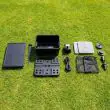
Five things: the SE 2000 pump (1400 LPH at 0m head), a 40W MPPT polycrystalline solar panel with ground spike, a LiFePO4 12.8V 7600mAh battery, a 20-litre filter bucket with dual filter pads and 2 mesh media bags, and fountain heads. The optional 5W UV clarifier (+£59.99) connects inline if you want algae control. No mains wiring needed — just charge the battery for 24-48 hours and run.
Do I need to add the UV clarifier?
Only if your pond turns green. The 5W LED UV clarifier (+£59.99) sits inline between the pump and filter bucket, sterilising free-floating algae as water passes through — useful for ponds prone to summer green-water blooms. Clear-water ponds with established biological filtration don't need it. The UV pulls about 5W from the battery so impact on runtime is small.
What size pond is this designed for?
Up to 2,000 litres for a wildlife pond, or 1,500 litres with light fish stock. Heavier fish stocking (koi or densely populated goldfish) wants only 1,000 litres and ideally a separate biological filter alongside. The 20-litre filter bucket is three times the size of the standard eco filters used in smaller kits — meaning longer cleaning intervals.
Сonsultation
If you have questions, please ask, do not hesitate,we are always happy to help you