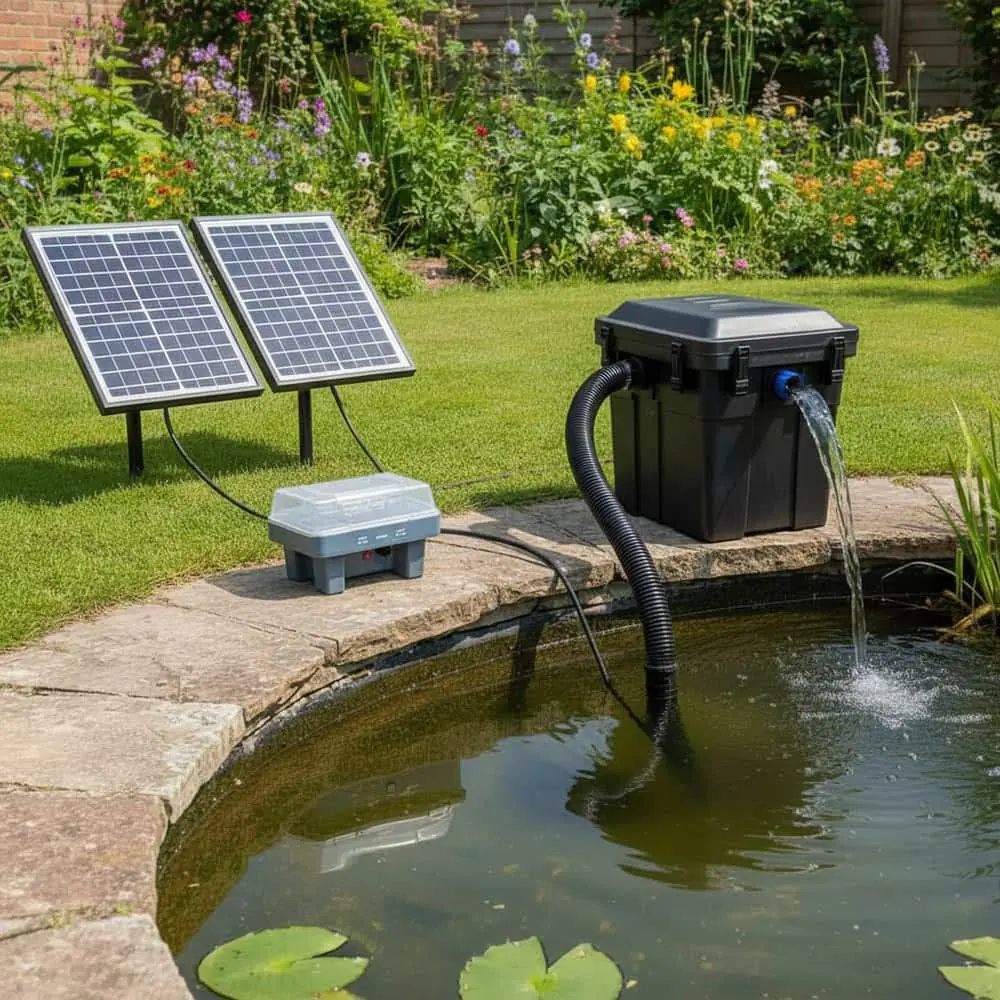
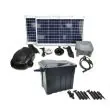
The most powerful filter in the range – clears ponds up to 8000 litres with UV clarification, dual filtration, and 2800 LPH flow from twin 80W MPPT panels with optional battery backup.
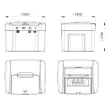
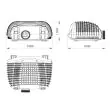
Set the system up as a complete pump-and-filter circuit, with the filter box positioned so water can be returned to the pond after passing through the different media stages. This layout helps you plan space for the filter chamber and choose whether to run the standard version or select the integrated UVC option where required.
✓ Up to 2800 LPH Flow Rate✓ For Ponds up to 8000 L*✓ Multi-Stage Filtration✓ Optional UVC Clarifier✓ MPPT Solar Efficiency✓ Battery Options Available
As with all solar-powered filtration systems, output depends on sunlight availability. Best performance is achieved in direct sunlight, with reduced output during prolonged overcast conditions or outside peak summer months.
Pond Suitability
Pond Size
Suitable for medium to large ponds when correctly sized and stocked.
No fish: up to 8000 L
Light fish stock: up to 5000 L
Heavier stock: additional filtration advised
Sunlight Requirements
Designed for solar operation using high-efficiency MPPT control. Performance varies with weather, season, and panel placement.
Water Features
Supports circulation, waterfalls, and return flows where pumping height requirements are within system limits.
Filtration System Design
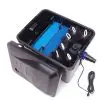
The filter box uses multiple filtration stages to manage both visible debris and dissolved waste. Mechanical filtration removes solids, while biological media supports beneficial bacteria that help maintain balanced pond conditions.
Mechanical Filtration
Brush elements and layered foam filters capture leaves, sludge, and suspended debris before water returns to the pond.
Biological Filtration
Ceramic biomedia supports bacterial growth to help break down fish waste and organic matter naturally.
Maintenance Access
Large filter chamber with removable components for straightforward cleaning and seasonal servicing.
UVC Clarifier Option
This system is available with or without an integrated UVC clarifier. The UVC version helps reduce green water algae by sterilising free-floating algae as water passes through the filter chamber.
UVC wavelength: 265–315 nm
Lamp power: 5 W
Operates at night — dusk-sensor activated
Helps improve water clarity
Important: When the UVC option is selected, a battery system is required to power the UVC lamp via the light output on the MPPT battery controller. This output is dusk-activated, so when stored power is available the UVC clarifier runs automatically after dark and stays off during the day.
Solar Pump & MPPT Power System
The system is powered by an 80W solar pump configuration using MPPT (Maximum Power Point Tracking) technology. MPPT continuously adjusts power input to maximise usable energy from available sunlight, improving real-world performance in changing conditions.
Solar Pump Performance
Maximum flow rate: 2800 LPH
Maximum head height: 1.8 m
Brushless DC motor
Dry-run protection
MPPT Efficiency
Optimised solar input
Improved low-light performance
More stable daily operation
Exclusive MPPT Technology – Developed for Solar Pond Pumps
PowerBee Ltd was the first company to introduce MPPT-managed control systems into small garden and pond solar pumps — a level of solar optimisation previously used mainly in larger-scale applications.
Our MPPT design helps improve energy conversion in variable light, supporting more consistent flow and stronger usable performance in real UK conditions.
Battery backup options allow energy collected during sunny periods to be stored and used when light levels drop. This helps stabilise filtration and, when fitted, enables UVC operation.
Battery optional on non-UVC configurations
Battery required when UVC is fitted
LiFePO4 chemistry for long service life
Supports extended daily runtime
How the Power Priority Works
The pump is the priority circuit. During the day the system runs the pump first from available solar power, and any surplus is stored in the battery. Once it gets dark, any remaining stored power is then used to additionally run the UVC clarifier.
Standard operation
Leave the unit switched on. The pump runs through the day on solar power, and the UVC clarifier runs after dark whenever there is stored energy available.
To prioritise the UVC at night
Switch the unit off during the day so the pump does not run — this lets the battery bank the full day's solar energy. Then switch it back on at dusk, and the system will run the pump and UVC clarifier together through the night from the stored charge.
Flow Rate by Pumping Height
Height
Flow Rate
0 m
Up to 2800 LPH
0.6 m
Approx. 2000 LPH
1.2 m
Approx. 1200 LPH
1.8 m
0 LPH (auto shut-off)
Performance figures are indicative and based on controlled testing. Actual results vary with sunlight, installation height, and system configuration.
Our solar pump systems are spring and summer products. They run on the sunlight available on the day, so output falls as the sun weakens from autumn onwards, and on dull or overcast days there may be little or no running. Follow this guide for proper setup, seasonal adjustments, and maintenance to maximize performance and product life.
Discover the operational principles and realistic performance expectations of your
energy-efficient water pump system throughout the seasons. This guide helps you
understand your system's capabilities and how to maximize its potential.
1. Operating Principles
Energy Collection
The panel captures sunlight and converts it to electrical energy
Energy powers the pump directly or charges the battery (in backup models)
System activation depends on light intensity and system type
Performance varies significantly with weather conditions
System Types
Direct Systems: Function only with sufficient direct sunlight
Battery-Backed Systems: Store energy for more consistent operation
Hybrid Systems: Combine immediate operation with energy storage
Each type offers different benefits based on your specific needs
2. Realistic Performance Expectations
Direct Systems Performance
Operation strictly dependent on available sunlight
Flow varies continuously with passing clouds
May start and stop multiple times on partly cloudy days
Strongest performance during midday hours with direct sun
No operation during evening or heavily overcast conditions
Battery-Backed Systems Performance
More consistent operation throughout the day
Continues running during brief cloudy periods
Provides operation after sunset (typically 1–8 hours depending on model)
Maintains steadier flow rate regardless of minor light variations
May include adjustable flow settings and timer functions
3. Seasonal Performance
Summer Performance (May to August)
Peak performance period for all system types
Direct Systems: Operation possible from early morning to evening on clear days
Battery Systems: Consistent daytime operation plus evening hours
Maximum flow rates achieved during direct midday sun
What size pond is this filtration system designed for?
Up to 8000 litres for a fish-free pond, or up to 5000 litres with light fish stock. Heavier stocking pushes you towards adding more filtration alongside it. The 2800 LPH pump turns the full pond volume over comfortably for a system this size.
Do I need the UV clarifier version?
The UV (PF-35L) version helps control green-water algae by sterilising free-floating algae as water passes through. Useful if your pond gets persistent green-water blooms. The non-UV (PF-35) is fine for clear-water ponds with proper biological filtration. The UV version requires the optional battery to power its 5W lamp.
How does the filtration actually work?
Three stages. Brush filter bars catch leaves and large debris first. Then two foam layers (one coarse, one fine) capture the smaller particles. Finally, four bags of ceramic biomedia provide surface area for beneficial bacteria to break down fish waste and ammonia. Cleaning is done by removing the lid and rinsing the foams in pond water.
Сonsultation
If you have questions, please ask, do not hesitate,we are always happy to help you